
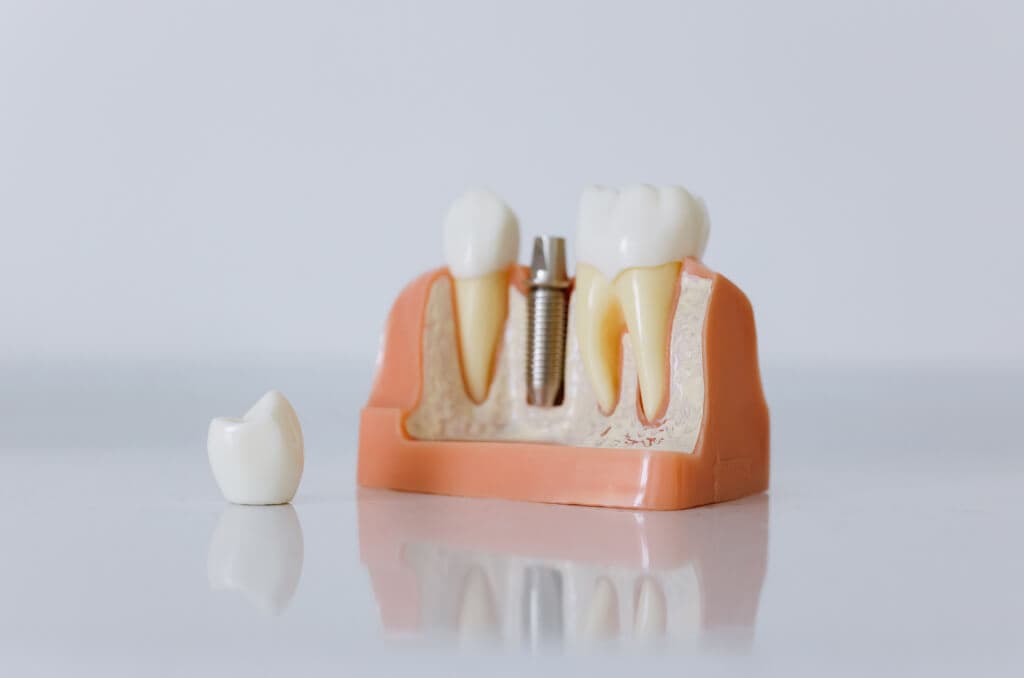
Dental implants as the best replacement for a lost tooth
An implant is a titanium screw placed in the jawbone, which it fuses with, and its purpose is to replace the root of a missing or lost tooth. Implants are a lasting answer to lost teeth above all because they are structurally and functionally joined to the bone. They are also more durable and considerably stronger than their predecessors, bridges and dentures.
Although most implants are made of titanium, the first ceramic implants have appeared recently, made of zirconia. Implants are entirely invisible, since they sit below the gum. Put simply, an implant is the foundation for a crown or a bridge that replaces one or more missing teeth.
When are implants indicated?
There are several situations that call for an implant:
- Replacing one tooth — if a single tooth is missing, it can easily be replaced with an implant and a ceramic crown fitted to it.
- Replacing several teeth — where several teeth have been lost, implants can be placed to carry a bridge.
- Replacing all the teeth — where no teeth remain, bridges can be fitted to replace them all. The other option is a comfortable, stable denture that replaces the loss entirely.
What losing a tooth leads to
Losing one or more teeth affects chewing. That in turn leads to various disturbances in the body, and to problems of appearance. It can also be awkward, and make everyday conversation harder.
Teeth preserve the jawbone through chewing, so where teeth are missing the bone is gradually lost. The bone is the foundation for the muscles of the face, so as bone is lost the facial muscles go with it. Over time, as that support disappears, the face takes on an aged appearance — which brings further problems of appearance and function.
Why implants are better than bridges and dentures
Implants are a considerably better answer, with several features that make them preferable to bridges and dentures. They have proved a much better option for patients who have lost teeth.
- Appearance — a patient with implants looks and feels exactly as they would with their own teeth. Implants fuse firmly with the jawbone, which prevents both the bone loss and the gum recession that often follow dentures and bridges. Even looking directly at someone with implants you would not see the difference.
- Confidence and comfort — after implants are placed, patients can speak, eat and chew normally again. Dentures often slip and can rub considerably; patients frequently complain of the unpleasant sense of something foreign in the mouth. Implants give comfort, and the confidence you thought you had lost.
They preserve the remaining teeth — dental implants do not affect the remaining teeth, which is often not the case with bridges. The more healthy teeth you keep, the better the long-term health of your mouth.
How an implant is placed
Placing an implant includes the period after it is in. The work, with the crowns and bridges it carries, divides into several stages.
- A treatment plan — a clinical examination by the implantologist or surgeon, and analysis of X-rays of the teeth or the jaw.
- Placing the implant — the surgical procedure of fitting the implant itself.
- Osseointegration — after placement there is a wait of three to six months for the implant to fuse with the surrounding bone.
- Fitting the superstructure — after osseointegration, impressions are taken for the crowns and bridges.
- The final stage — fitting the bridges and crowns.
An implant replaces a lost tooth
Implants are the best replacement for a lost tooth because they preserve all the surrounding teeth. They have the further advantage of taking the forces created by chewing and transmitting them to the jawbone, which prevents the bone resorbing.
By the standards of modern dentistry, the best reason for using an implant to replace a lost tooth is that implants behave, and feel, very much like natural teeth.
Looking after implants
Looking after implants extends their life and their function. If a patient neglects them, a reaction called peri-implantitis can follow: an inflammatory condition that changes the soft tissue and bone around the implant. Regular care easily avoids any discomfort or change, and lets implants last for many years.
To keep a single implant clean you should:
- Use a soft or ultra-soft toothbrush.
- Brush at least twice a day.
- Use a water flosser.
- Use floss, and floss made for bridges.
- Use non-abrasive toothpastes.
- Brush around and under the crown on the implant.
It is also worth seeing your dentist at least once a year for a check-up and a clean. And if you notice that you grind your teeth at night, tell your dentist sooner rather than later: it is damaging to healthy teeth and particularly to implants.
Dental implants: common questions
- Does placing an implant hurt?
- Placing a dental implant is painless and is done under local anaesthetic. During the procedure you may hear the unpleasant sound of drilling and turning, but you should not feel pain where the tissue is healthy. It is reassuring that placing an implant is considered an easier procedure than extracting a tooth. If you are anxious about it, a sedative before the procedure can be recommended.
- How long do dental implants last?
- In principle, a properly placed implant should last a lifetime. Poor hygiene and irregular dental visits can undermine it, though, exactly as they do natural teeth. No one can guarantee how long an implant will last, because a person's health depends on many factors and mostly on the person. So what patients with implants have to do is keep both their natural teeth and their implants clean, and see a dentist regularly.
Book an examination
A first examination is not charged for. You choose an appointment online, in a few steps, or call us.